Healthcare and Social Protection on St. Maarten / St. Martin — What You Need to Know
One of the quiet surprises awaiting anyone who spends serious time on St. Maarten / St. Martin — whether as a long-stay visitor, a prospective resident, or someone considering making the island home — is the quality and accessibility of the social protection systems on both sides of the border. The assumption that a small Caribbean island means improvised healthcare and no safety net is wrong, and in some respects dramatically so.
The French side: a European system in the Caribbean
Saint-Martin is not a colony or a tourist enclave with a thin administrative veneer. It is French territory, subject to French law, and connected to the full apparatus of the French social state. That includes healthcare, pension rights, and a remarkably accessible path to legal self-employment.
The French government has created a business structure specifically designed for overseas territories like Saint-Martin: the micro-entreprise, informally known as the mini-company. Its purpose is to ensure that every member of the community — regardless of educational background, professional qualifications, or administrative experience — can establish a legitimate independent business and immediately access the social protection that comes with it.
The mechanics are intentionally simple. There is no accounting requirement. The business owner declares monthly revenue to the government, and the state applies a fixed formula: a percentage is assumed to represent costs, the remainder is treated as profit, and taxation is calculated on that basis. For small operators, the resulting tax burden is modest. The system is designed for accessibility, not complexity.
The more significant benefit arrives immediately upon registration: a Carte Vitale is issued. This is the French national health insurance card, the same document carried by residents of Paris or Lyon, valid in Saint-Martin and honored across the French healthcare system including Guadeloupe, Martinique, and metropolitan France.
What the Carte Vitale Means in Practice
The French health system covers the overwhelming majority of medical costs for cardholders. What remains after reimbursement is typically a small supplementary amount — and even that can be contested through the CAF, the Caisse d'Allocations Familiales, the government body that exists specifically to ensure no resident faces financial barriers to essential services.
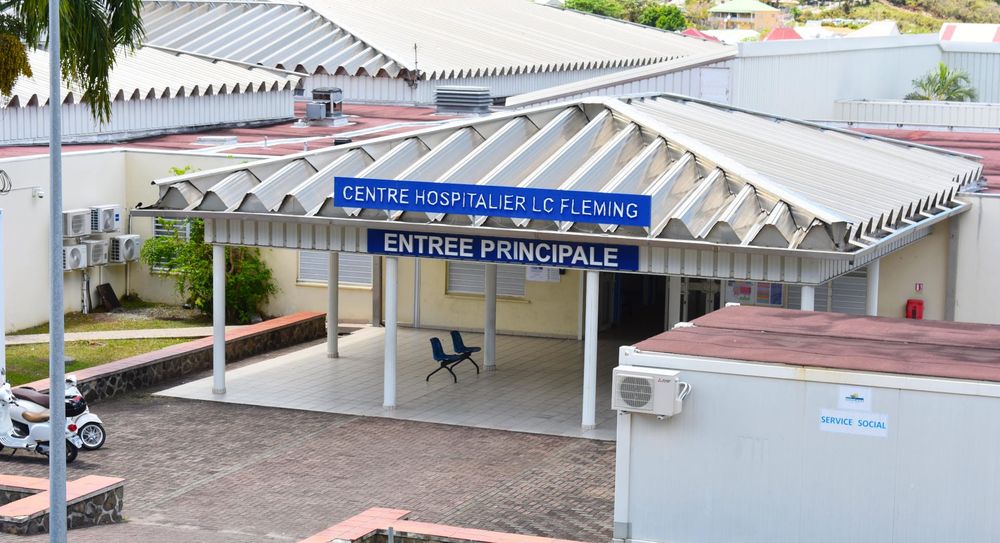
To illustrate what this means in concrete terms: a resident of Saint-Martin who arrived at the Hôpital Louis-Constant Fleming presenting with symptoms consistent with a stroke recently received a full CT scan, followed by imaging on more sophisticated equipment, with the hospital's own ambulance aircraft prepared for immediate evacuation to Guadeloupe pending the results. The total amount billed after French insurance reimbursement: €18. The attending staff then advised the patient that even this amount could be waived entirely by visiting the CAF office — no questions asked, no stigma attached.
The Hôpital Louis-Constant Fleming maintains its own dedicated ambulance aircraft for medical evacuations to Guadeloupe or Martinique. When the situation demands it, patients can be transferred to metropolitan France. This is not a theoretical capability. It is operational infrastructure on a 37-square-mile island.
The Dutch Side: a Different System, the Same Fundamental Guarantee
Sint Maarten operates under Dutch Caribbean law with a different healthcare framework — there is no equivalent of the Carte Vitale, and the social protection architecture is less comprehensive than the French system. For residents and long-stay visitors without insurance, the Dutch side requires more planning.
What the Dutch side shares with the French side, however, is something less institutional and more human: the island's approach to medical emergencies does not begin with a financial conversation.
An island resident involved in a serious road accident on the Dutch side — motorcycle versus car, significant injuries, police and ambulance on the scene — found that the responding officers' primary and repeated concern was not liability, not documentation, not insurance status. It was whether the injured person was willing to accept care. The police made it clear, more than once, that cost was not a consideration and would not become one. The only thing that mattered was whether the person in front of them was going to be all right.
This is not written into any law. It reflects something about the character of the island and the people who work in its emergency services. But it is consistent across both sides of the border and worth knowing before you travel.
For Serious Emergencies: What Happens Next
Neither side of the island defaults to the United States for medical evacuations, and visitors should not assume otherwise. The French side coordinates transfers through its own aircraft to the larger French islands or metropolitan France. The Dutch side typically transfers serious cases to Colombia, which operates at a high standard of medical care and is geographically accessible from Sint Maarten.
American visitors who specifically require repatriation to the United States for medical reasons should arrange dedicated medical evacuation insurance before traveling. Skymed is one provider that has operated in this market for years and offers coverage tailored to Caribbean travelers.
For Those Considering Residency on the French Side
EU citizens can establish residency and work in Saint-Martin without restriction or application. The micro-entreprise registration process is straightforward, the Carte Vitale follows quickly, and pension rights accumulate from the first month of declared activity. The full weight of French social protection — healthcare, family benefits, pension — applies in an overseas territory with Caribbean weather, no income tax, and a cost of living that remains lower than metropolitan France for most categories of expenditure.
It is not a widely advertised combination. Those who have discovered it tend to stay.